
A deeper dive into Alliant’s Menlo Park advocacy plan — the people behind the bid to build on the downtown parking plazas and a strategy to “neutralize opposition.”
MonitorMenlo.news · Opinion · August 14, 2026 · Reports/Opinion
Alliant Communities’ bid in response to Menlo Park’s Request for Proposals seeking a developer to build housing on three city-owned downtown parking plazas contains a line that focuses its community-engagement plan into a three-part effort to “shape project messaging, educate voters and neutralize opposition.” (Emphasis added.)
That “opposition” is not hard to identify: a good share of the downtown business community and the grassroots citizen group Save Downtown Menlo, whose measure requiring a public vote before the plazas can be sold or leased reaches the ballot on November 3, 2026. It is a constituency that, by most accounts, one would seek to appease rather than neuter.
How Alliant would achieve this neutralizing is a question that relates as much to the developer’s community engagement team as it does to its tactics.
And that team is not new to Menlo Park. Alliant recently won City approval, and a $1 million City loan, for its 88-unit educator-housing project at 320 Sheridan Drive, on the former Flood School site. By Alliant’s own account, its downtown proposal “includes key consultants who supported our Sheridan Apartments project” — among them Kamangar Consulting, LT Strategic Communications, R3 Studios, Partner Energy, and the law firm Cox, Castle & Nicholson. By redeploying them downtown, Alliant says it is “leveraging their deep Menlo Park experience.”
This commentary takes a closer look at Alliant’s community engagement plan for the potential downtown parking-to-housing conversion, with special emphasis on its assembled outreach team. The players are tightly wired to Alliant, each other, and Menlo Park’s pro-housing machine, both inside and out of City Hall.
Community engagement is the heart of Alliant’s pitch for selling the community on the concepts of replacing surface parking with garages, high-rise apartments, and a reshaping of the downtown skyline. That engagement is the part of its RFP the City geared toward having its selected developer explain how it would calm community and business fears about lost parking, construction disruption, failed businesses, lost jobs, and merchant displacement.
Alliant’s bid documents promise an “intentional, comprehensive outreach campaign,” and the RFP is candid about the aim: the effort will build “strong advocacy and forming personal connections throughout Menlo Park, including the downtown business community.”
Rather than rising to bring harmony and unity, Alliant squares up to say the priorities of its outreach are to “shape project messaging, educate voters and neutralize opposition.”
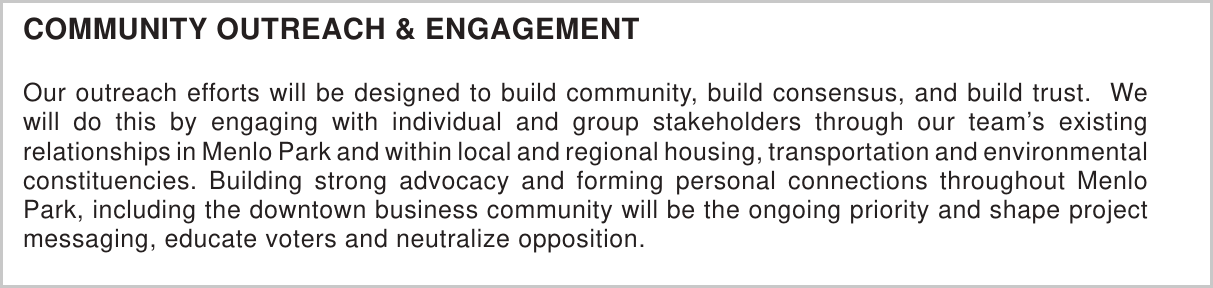
From Alliant’s RFP, Section E — Community Engagement.
Alliant’s language did not start so adversarial.
In a filing intended to show why Alliant had the qualifications to receive an invitation to bid filed on March 31, 2025, before the opposition hardened into a ballot campaign, the developer portrayed how its outreach would encourage consensus. It relied on inclusive terms, stating, “Strong advocacy and personal, local connections throughout Menlo Park, including the downtown business community” were already “the ongoing priority.”

Alliant’s March 2025 qualifications submittal framed the same outreach as a bid for a project “all members of the community can support.”
Most notably, it glossed that intent with positivity by saying the goal of its community engagement was to create a development that “ultimately, all members of the community can support.” It said it would work toward that end through “an equitable community participation process by giving everyone a voice.”
Eight months later — after Save Downtown Menlo had gathered its signatures and the Council had placed the measure on the ballot — Alliant’s December RFP filing kept some of that language, but with an expanded and targeted ending, saying the priority would “shape project messaging, educate voters and neutralize opposition.”
The engagement team looked the same in both documents, but Alliant’s posture had changed from equitable community participation to quieting the opposition.
To be sure, Alliant’s outside advisor roster barely changed between its two filings.
Every consultant this piece follows — Kamangar for entitlements, LT Strategic for outreach, R3 Studios, Partner Energy, Cox Castle — was on the qualifications team too, each billed then as the crew from Sheridan. The lone substitution was the architect: KTGY, whose pitch had touted “direct experience in Menlo Park,” gave way to Oakland’s Lowney Architecture.
The qualifications submittal also disclosed the two threads that follow — Kamangar’s seat on Eden Housing’s board, and LT’s recent campaign work “for San Mateo County Supervisors Lisa Gauthier and Ray Mueller.”
Alliant’s filings made clear who it would enlist as supporters. Under “Stakeholders will include,” the plan is heavy on listing pro-housing advocates and advocacy groups Housing Leadership Council, Menlo Together, and Menlo Spark. The plan explains how Alliant will “leverage Housing Advocate outreach partnership opportunities” and to place “Op eds, Letters to Editor” in the press. The firm running it, LT Strategic Communications, describes its own specialty as “community engagement, political strategy, and stakeholder outreach.”
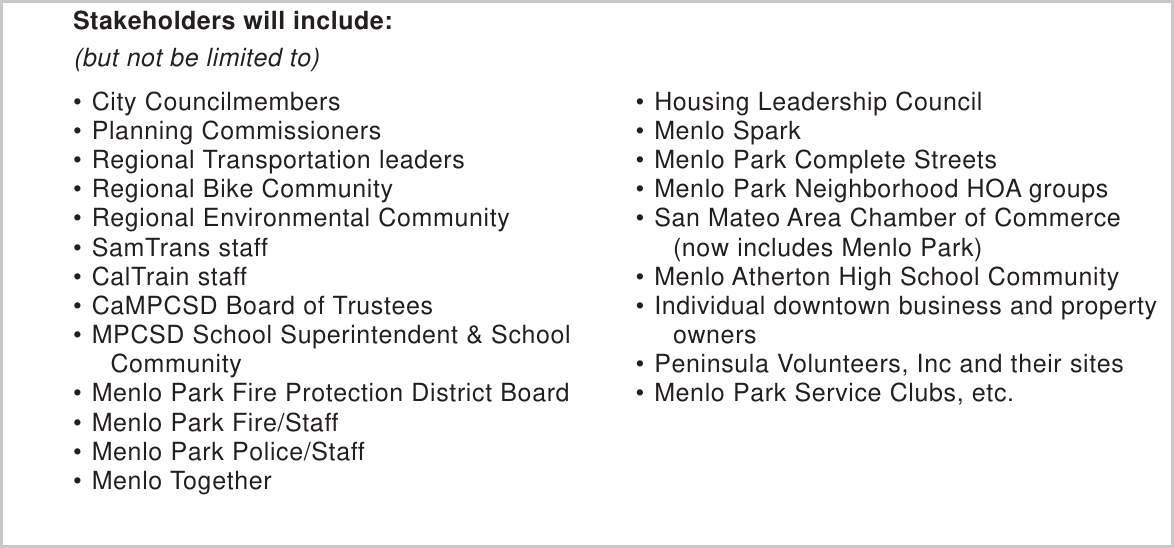
Alliant’s RFP stakeholder list places Housing Leadership Council, Menlo Spark, and Menlo Together beside ‘individual downtown business and property owners.’
As most anyone conversant with the downtown debate knows, many on Alliant’s list of stakeholders are not neutral toward one another on the issue of giving away downtown parking lots. Without naming which “individual downtown business and property owners” it will engage and by referencing the San Mateo Area Chamber of Commerce, Alliant does give lip service to the opposition.
And it is a certainty that many, if not most, in the downtown business community are on the other side of Alliant, Housing Leadership Council, Menlo Together, and Menlo Spark on whether downtown or alternate sites are better for building the 345 or so units the City seeks. The facts show that 135 downtown businesses have publicly said the plan threatens their businesses and the jobs they provide, and Save Downtown Menlo gathered nearly 4,000 signatures to put its measure on the ballot. The Housing Leadership Council — named in Alliant’s plan as an outreach partner — sits opposite them: its Menlo Park affordable-homes campaign backs the downtown housing, and an affiliated committee sponsored by Housing Leadership Action of San Mateo County is organizing against the very measure supported by downtown merchants. To that end, HLC’s action arm, along with Karen Grove, John Sobrato, and Robert McGrew, have provided the bulk of the funding and staffing for the sole registered Vote No campaign organization opposing SDM’s ballot measure.
So, before the Council counts community engagement as a strength of Alliant’s bid, it might want to look closely at whether an outreach process that names one side’s advocates as partners, and describes its own goal as to “neutralize opposition,” can engage every constituency — the downtown merchants included — fairly and equally.
As Alliant has framed it so far, and by looking at the community engagement team it says it will rely upon, the answer stands as “no.”
Without revision, and perhaps an awakening, Alliant has made clear that to it community engagement is more to persuade than listen, more to “educate voters and neutralize opposition.”
Further, as described below, players in Alliant’s community engagement team and its reliance on a character reference from a top city official only reinforce that point.
The consultant at the center of Alliant’s community engagement plan is LT Strategic Communications, led by Laura Teutschel. LT, which also was Alliant’s engagement consultant on the Sheridan project, also has handled community outreach for the redevelopment of the former USGS campus, a Presidio Bay Ventures project. Interestingly, Presidio Bay is one of Alliant’s two rivals for the plazas. And LT’s longtime client roster includes the Housing Leadership Council, the same advocacy group named as a key stakeholder in Alliant’s outreach plan and the same group who has an affiliate now helping lead the campaign against the merchants’ ballot measure. LT’s portfolio also lists past Menlo Park council campaigns, including former councilman Ray Mueller’s, though none for a current member or a 2026 candidate.
The money, though, tells a narrower story than LT’s client list implies. The Housing Leadership Council’s 2022 “No on V” committee does not show any payments to LT Strategic Communications or to Teutschel in its campaign filings; its paid consultants were Cleansweep Campaigns, the pollster EMC Research, and the law firm Miller & Olson.
HLCSMC’s IRS filings, in turn, itemize no payment to LT — the group reported no outside contractor above the $100,000 disclosure line, and books its consulting spend as a single lump sum.
So, it appears that LT sits inside the pro-housing coalition based on client relationships, not by any fee-based engagements by stakeholders in this issue.
Alliant’s documentation, purposely or otherwise, extended the reach of its proponent team into City Hall itself.
In its RFP papers, Alliant lists the City’s own top executive as a reference: “Reference: Justin Murphy, City Manager, City of Menlo Park.” Alliant says Murphy can vouch for its work on the Sheridan project, which the City helped fund.
Murphy is a career Menlo Park staffer — he joined the City in 1996 and rose through planning, community development, and public works before the Council named him City Manager in 2022.
The Sheridan project he could speak to is one his office actively must administer. On April 28, 2026, the Council authorized the City’s $1 million loan agreement with the Sheridan partnership (agenda item G9). That agreement designates the City Manager as the City’s “Authorized Representative” (§ 4.6) — making Murphy the person who administers and can make certain contract changes without a public meeting. (§ 5.1; default under § 10.1(a)).
In some respects, this puts Murphy on two sides of Alliant’s dealings with the City: he is a reference for it on the new bid, and is the officer whose office runs Alliant’s existing, City-funded deal.
Two things temper that. The final choice of a plaza developer belongs to the City Council, not the City Manager; and serving as a reference for a completed, Council-approved project might be ordinary.
Here, however, construction just started on the Sheridan project, and it is a long way from completion. Further, Murphy’s staff will help evaluate the three parking plaza proposals and they cannot ignore that their boss is listed by Alliant among the references willing to speak on its behalf.
One other consultant has an unusual tie to both Alliant and the downtown parking project. Kamangar Consulting handled zoning and code compliance on Alliant’s Sheridan project, and Katia Kamangar is back on Alliant’s plaza team.
She also sits on the board of Eden Housing, one of the six teams the City pre-qualified to submit RFP responses to build the plazas. On the Eden site, she is described as the “founder and principal at Kamangar Consulting, LLC, a strategic real estate advisory firm” who has more than “25 years of experience in residential and mixed-use real estate development.” Eden’s web page further lists Kamangar as its treasurer, so presumably she has a working knowledge of project costs and viability. Notably, by the City’s account, Eden was the only one of six developers it invited to bid at the RFP stage to tell staff that replacing the 556 public parking spaces at no cost to the City was “infeasible.” Eden thereafter declined to bid when RFP responses were due.
That presents a sharp overlap: Alliant’s entitlements adviser is a board member and the listed treasurer of a competing developer whose public assessment was that Alliant’s central promise — full replacement of 556 downtown parking spots without a City subsidy beyond the contribution of land — was not attainable.
Nothing in the record suggests Kamangar’s board seat or treasurer role shaped Eden’s decision to walk away, and her downtown parking plaza engagement is for Alliant.
But the divergence between Eden and Alliant on the viability of completing a project with 556 public parking spots despite the absence of supplemental City funding begs for an answer from Kamangar on which of the two developers she is affiliated with made the better assessment.
Kamangar’s other affiliations are a matter of record: a board seat at Housing Trust Silicon Valley, a past turn as a City of Los Altos Planning Commissioner, and a role with the Building Industry Association of the Bay Area. Her professional bio markets “strong connections with local city staff and elected leaders,” though it names none in Menlo Park.
For all the overlap, parts of the record are notably empty. Records do not show that Alliant made any contributions recently to Council candidates or ballot issue campaigns. And no firm on Alliant’s team also sits on the City’s side of the table: the City’s outside counsel is City Attorney Nira Doherty’s firm, Burke, Williams & Sorensen, and its communications consultant is Tripepi Smith — not Cox Castle or LT Strategic.
What this deeper dive shows instead is that Alliant built its bid on continuity where it will call on community engagement advisors it relied on in the past to assemble and execute a plan that names the downtown merchants and the Save Downtown Menlo group as the opposition it thinks needs to be neutralized.
That strategy and the long-term impacts of its success on community acceptance and cohesiveness are factors the Council must weigh if it opts to proceed with the parking lot conversion instead of finding other sites that do not present financing difficulties and irreparable division.
And, if Alliant is the only RFP respondent who met the City’s requirements and priorities for downtown construction, the Council will face the ultimate question whether Alliant is the partner it wants to work with for the term of a 55-year land lease considering how the firm openly set out to neutralize opposition rather than bring consensus.
Sources. Alliant Communities RFP and qualifications submittals for Downtown Parking Plazas 1, 2 & 3 (City of Menlo Park), including the reference list, the “consultants who supported our Sheridan Apartments project” statement, and Section E “Community Engagement” (outreach goal to “educate voters and neutralize opposition”; stakeholder list naming Housing Leadership Council, Menlo Together, Menlo Spark, and downtown business and property owners). Sheridan / 320 Sheridan Drive: City Council funding-agreement item G9 (Apr. 28, 2026) and approved minutes; Planning Commission approval (Jan. 2025) and Council denial of appeal (Mar. 11, 2025); The Almanac, “Menlo Park to contribute $1M to teacher housing project” (Nov. 22, 2024) and “City Council rejects appeal” (Mar. 15, 2025). Justin Murphy: City of Menlo Park (City Manager appointment, June 2022). Katia Kamangar: Eden Housing board; Housing Trust Silicon Valley; City of Los Altos. Laura Teutschel / LT Strategic Communications: LT client and campaign pages (ltstrategy.net); InMenlo (USGS-site community meetings, 2025). Save Downtown Menlo / Downtown Parking Plazas Ordinance (Nov. 3, 2026 ballot; ~4,000 signatures; 135 downtown businesses opposed): savedowntownmenlo.org; The Almanac and Local News Matters (Dec. 2025). Housing Leadership Council of San Mateo County, “Menlo Park Neighbors for Affordable Homes” (hlcsmc.org), and the committee sponsored by Housing Leadership Action of San Mateo County. “No on V” committee Form 460 filings (Menlo Park NetFile) — payees Cleansweep Campaigns, EMC Research, Miller & Olson; HLCSMC IRS Form 990 (ProPublica Nonprofit Explorer, EIN 94-3395945). City outside counsel: The Almanac (Feb. 2021); City communications consultant Tripepi Smith (City Council agreement, June 9, 2026). This is a review of public records and does not allege wrongdoing.